(This is an address to young ladies about t necessity of chivalry in our God-given task of womanhood. The main meat of it is taken from J. Aaron Gruben's work, which can be found here and here.)
“Hige sceal þe heardra, heorte þe cenre,
Mod sceal þe mare þe ure maegen lytlað.”
(“Courage must be the firmer heart the bolder
Spirit the greater as our strength lessens.”)
-Battle of Maldon
The pagan’s axe came at his head in a mighty swing. Thorvald caught it on his shield, and felt the heavy blade slide down to ring on his metal buckler. All around him the wounded and dying screamed, the pagans and his fellow Saxons bellowed, and the clash of weapon against weapon and bone rolled in an unceasing wave. Thorvald slammed his shield into his enemy, driving the man’s own weapon into his face. A crunch sounded in the midst of the battle’s clammer, and his enemy crumpled bleeding in front of him. Thorvald had an instant to stand and pant. His limbs shook with fatigue after the hours of battle. His eyes lifted to search the hill desperately for his king’s banner. There, the standard still flew! Their king still held the field. Good heavens, it had nearly reached the pagans triple raven standard. They did meet! The kings had come together! Thorvald stood tense and staring as the battle raged around him, his whole being focused on those two waving flags above the mass of fighting men. The king’s banner trembled and tipped. Thorvald felt a scream rising in his throat. But then the pole caught, the standard rose again and stood steady. Oh thank the maker it stood steady! The Raven standard shook. Then it tipped! The triple raven crashed amidst the bloody field, and the scream turned into a roar of victory as it ripped from Thorvald. New strength flooded his tired muscles and he turned back to the enemy and charged, yelling the news to his brothers. The enemy standard was down. The field was theirs!
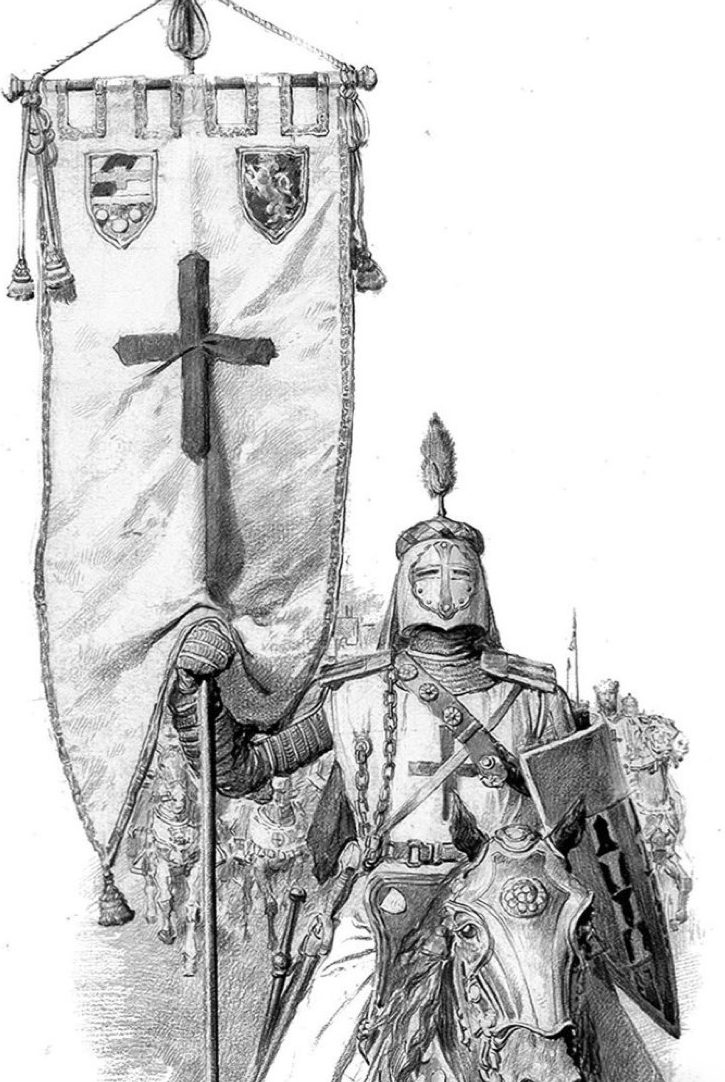
Being named Standard-Bearer was a great honor. It meant a place near the king on the battlefield, and usually went to a relative the king knew he could trust. The Standard-Bearer isn’t really there to fight. He’s there to hold rock steady beside his king and show others the way. And he must be steady. Because a Standard-Bearer’s job is perilous to heart and body, and if they falter, the battle might very well be lost. In a field of war the soldiers look for the standard of their leader for direction, and if the standard falls, it’s usually assumed the leader is dead; if the leader is dead, panic takes the troops, and many break and run, which gives renewed heart to the enemy fighters… If the standard falls, the battle is often lost. And the enemy knows that. They single in on the place with the standard, knowing the king stands there with his entourage, and if they take out the king, the path to victory is easy. The enemy hones in on exactly where the Standard-Bearer holds fast beside his king. It took a particular kind of courage to be a Standard-Bearer.
You, daughter of the King, are a Standard-Bearer. And in this day, your job is harder and more perilous than in many a past age. It takes a particular kind of courage and carefully nurtured skills to be that kind of warrior. It takes the habits of a chivalrous heart.
Chivalry means more than a man giving up his seat for a lady, or even a shining knight on a white horse. Chivalry is a way of living. It is continually laying down your wants for those around you. It is being strong when you feel the weakest. It’s loving God so much every breath is used to serve Him and His people. Chivalry is codefied Christian servanthood.
What does that mean exactly? We’re going to break that sentence up into the ten “commandments” of Chivalry. In the 1800s a man named Gautier compiled the chivalry created over the ages into these ten laws, and a man named J. Aaron Gruben took Gautier’s and adapted them for our times. This is a brief introduction to a book written by Mr. Gruben that I hope you'll find to study. We are delving into a deep topic, one that I hope will begin to permeate your life and give you strength everyday. Because a woman has to be strong to do what God intended for her. We are needed, ladies. We are needed more in our culture today than in many a past age. Let’s begin, and I’ll try to tell you why.
Commandment 1: “You shall believe and obey the Bible and devote yourself wholly to Christ.”
The year is 625. Northern England is a place of pagan rituals, of dark warriors laying waste to the lands, squabbling for power and greed. Not long before, all of England was like this, the rule of might held sway, people lived in darkness, and died in darkness, with no hope in sight.
But then the missionaries came. Two priests arrived from Rome, and a light leapt into the dark. It took root in Kent, one of the many independent kingdoms that made up England at that time. Christianity began to bloom in the heart of the warrior kings.
Now, in 625, a pagan king named Edwin asked for the hand of a princess from Kent. Her name was Athelburh. Daughter of kings, a woman of Christ, she knew what it was like in Edwin’s kingdom of Northumbria, and she knew something most people seem to have given up today. A woman has an influence like no one else. A woman can change the world, if she sets her mind to it. Athelburh made a clause in the marriage contract; Edwin must be baptized into the Christian faith, and Athelburh must be allowed to bring her priest, Paulinious, with her to Northumbria. Edwin gladly agreed, became a Christian, and the daughter of kings became a mother of kings, and a shaper of a continent.
The light spread from queen Athelburh. By the time she was an old woman, monasteries (think Christian schools, solid churches, places of learning and places to worship), were scattered all through the North of England and moving on. A woman she helped to rear, Hild, her step-daughter, became Abbess of Whitbey, renowned for her godly wisdom and goodness, a woman kings came to for council. It was Hild who found Caedmon, a lowly Shepard, and helped to preserve his poetic psalm to God, one of the earliest poems we have in the English language. In just a few years, the light of hope had spread so far even the shepherds were praising the God who made everything.
This is the prerequisite to chivalry. You can’t live out any of the other commandments if you miss this. You must love Christ. You must be a true Christian, someone who is so wholly devoted to Christ you are willing to stand up to your peers, your father, your husband, to anyone in your life and hold out the gospel. You must cling to the cross so hard nothing can shake you from it, so hard Christ goes with you everywhere you set your foot. But don’t miss the first bit of this commandment; you must believe the Bible. Many people in the early Middle Ages held to a sort of mix of Christian and pagan ideas. As things shifted, it gradually became socially “right” to have some Christianity in your life, and people began to mix their old ways with the new, without understanding what the gospel really said. This is where people like Hild, the Abbess of Whitbey were so crucial, and where you must be firm. There is real truth. What you believe matters, all of what you believe. You can’t take the parts of Christianity you like and throw out the rest, which is what people throughout all ages try to do. You have to know the whole truth. You have to know your Bible. If you want to be a world changer like Athelburh, you have to know what you believe.
Study. Be diligent in your daily devotions, in your church going, in your Wednesday night studies. Take notes in church. Memorize as much scripture as you can every day. Know Who the Savior is, what the cross means for you, learn more of Christ every day and so fall deeper in love with Him. This is the first commandment of Chivalry.
Commandment 2: “You shall defend the church.”
“718. In this year Ingeld, the brother of Ine, passed away, and their sisters were Cwenburh and Cuthburh; and that Cuthburh founded the monastic community at Wimborne:” – The Anglo-Saxon Chronicle
The two sisters aren’t mentioned anywhere but in this; they helped to found the abbey. All over the old stories, the ladies are the ones named who are pushing the church forward, founding the abbeys, stepping in to shelter the monks with their favor, or placing their wards in the cloisters to learn. Don’t misunderstand, men did these things too. But the ladies are especially mentioned. Let me say it again, we have an influence. And we also tend to have a vision. This isn’t saying men never look to the future! But we are the child bearers, and often (especially in history) the child-rearers, and when you have a baby in your arms, you start thinking about what the world is going to look like in twenty years. This isn’t an accident. This isn’t a result of chance making us the ones biologically able to bear children. God did this. We are made to help build the future. Building up the church is a large part of this commandment. We are to be the hands and feet of God, helping to plant churches, and to keep the churches strong.
Defend her from heresy. Again, know what you believe and hold to it with your whole heart. Defend her from being torn down by backbiters and talebearers. Be careful of your words, sisters! Gossiping can do more damage to the church than a maniac with a loaded gun.
This is as good a place as any to mention something that might not sit well with you; we are not primarily warriors. In the middle ages, ladies knew how to fight and many a woman defended their homeland and their people when the fellas weren’t around (more on that later). But our primary purpose is not to take an active part in wars. However, this commandment is about defending the church. Through much of medieval history that wasn’t figurative. Pagan hoards broke against the Christian shields for years, and years, and years. Today we are still seeing real physical threats against the church, and not only in foreign countries. We defer the wars to our men. But defense is different. Defending ourselves and others is something we should all be able to do, immediately, if the situation calls for it. I pray you will never need it, but learn how to defend yourself, maybe even take a self defense course. Christ commands His people to be loving; but not helpless. Which brings us to the next commandment.
Commandment 3: “You shall be gentle to those weaker than you, and become their selfless defender wherever you find them.”
When your little brother interrupts your reading for the tenth time, asking for a drink of water, what’s your response? Your first inclination is probably to snap and send him away. But that’s not the chivalric way. We are to prefer others to ourselves. Especially those weaker, those younger, those who need us. It’s easy to imagine yourself as the gallant rescuer, defending your little siblings from an attacker. It’s a much harder thing to walk everyday beside them and continually be courteous and kind. But this is what is demanded of us by chivalry. We are to set an example of selfless gentleness.
For us, a very large part of this commandment is to act like a lady. Deferring the wars to our men isn’t a weakness on our part. It is a gentle, right way of pushing our menfolk to be who God made them to be. And here, in this commandment, is where we really start taking an active part in chivalry specifically by being women. Pause for just a moment and picture a world where the ladies still expect men to treat them with courtesy. The call goes out for dinner; the lady pauses at the door, waiting till the man gets the idea and opens it. She waits for him to help her with her chair, and offers a smile and a thank you instead of a huff of annoyance. This isn’t make believe, and it isn’t pointless! Just a few years ago, this was the world where we lived. And it formed men who leapt to the defense of any who needed it, and ladies who were strong and held the breach behind the men. Now, I get it sister, there is a part of us that balks when it comes to letting the men up front in this commandment. It takes patience, and a deep, deep inner strength to let a man be a man. Especially in our society of hyper feminism and gender confusion! But a lot of that confusion (dare I say all of it?) would disappear if ladies started acting like ladies again. If we hold up a standard to the men around us, and expect them to be knightly, they start to get the idea. Especially for those of you who have brothers, remember this rule for their sakes! You are their main training ground for the type of man they will become. Let them get the doors. Teach the younger ones to be polite, to be courteous. It forms so much more than proper manners. It forms the mindset of a knight. You are forming a mindset in them. Every day you live in the same house, you are teaching them something about womanhood. Will it be the Brunhilda kind of womanhood, who managed to kill almost every knight in her kingdom? Or will it be the Athelburh womanhood, a lady who forged new paths for Christ’s love to go out, and changed a whole kingdom by being a woman?
Ok, that being dealt with, there is also a real part of defense that falls to us. We need to know how to defend ourselves and others. In every age its needed, but more and more in today’s world, you should know things such as how to beat off an attacker, how to get out of a locked trunk, what danger signs to watch for, how to fire a gun safely. There are too many practical ways to prepare for this commandment for me to list them all here. But one of the main ones is simple; situational awareness. Don’t be paranoid, but do be informed, and be aware. When you walk into a large gathering, locate the exits. Think through what you would do if an armed attacker charged in. When you walk in and out of the grocery store, don’t be staring at your book or phone the whole time, keep aware of what is happening around you. This is the best defense we have, for ourselves and those around us. If we know what to watch for, and we’re doing our job, we might be able to spot a possible dangerous situation before it becomes dangerous.
Commandment 4: “You shall love your country.”
In the year 819 a baby was born to the King of Wessex. He had three older brothers, and each of them were graced with kingly names. But he was fourth in line, no one thought this babe would ever come to the throne! So the king let the queen name him. She chose Elf-Child, or, Alfred.
For years the Danes had run against the Wessex coast. Already Wessex was an island in the midst of the darkness of pagan invaders, as the Vikings overran the other kingdoms, and the kings were slain or capitulated to the Danes. Wessex fought, and fought again. First Alfred’s father died. Then his oldest brother. Then the second. Then his third brother, Æthelbal, was slain.
Alfred became King of Wessex. His was a Wessex already overrun by the Vikings. But Alfred didn’t throw up his hands and say, “Nothing more I can do here!” and seek peaceful asylum with relatives in another kingdom, though he could have. No, he stayed. He waged a sort of guerrilla warfare on the invaders, emerging in pitched battle when he could gather the men, and sometimes driven into hiding in the fens and swamps of his kingdom. For years Alfred lived on like this, with little hope of victory or it ever changing. But he stayed, and he fought, because he loved his country and his people, and he understood the Pagans came to snuff out the light of the gospel and supplant it with their own dark gods. Alfred fought on.
Once more, Alfred gathered a force of chieftains and met Guthrum, leader of The Great Heathen Army, on the field of battle. They met near Edington in May of 878. And there, at the Battle of Ethandun, Alfred and his forces won the day. They won hard, so much so that Guthrum chose to forsake the old gods and take on the cross. The Pagan leader was baptized, and the face of Wessex changed that day.
As the years ticked on, Viking hoards still came, and the fight didn’t fully end. But Ethandun marked a turning point. Gradually Wessex became the uniting point for England, until the scattered kingdoms joined to become the country we know. The sputtering light of Christianity flared in Wessex that day into a burning torch, that gradually drove the invading dark back into the sea.
We are privileged today. Our country is built on the foundations laid by great people, all the way back to King Alfred and before. (He was a lawmaker as well as a warrior and scholar). America is a country we can be proud of, and respect. This is a country where we can live free, to worship and serve our God as best as we can. It isn’t perfect. And that’s a large part of this commandment; we should be willing to spend our time and energy to try and keep our country free and following God’s laws. Especially in America, where the average citizen can make a difference.
The Bible tells us we are to give our country what is due her, for God is the One Who has placed our rulers in power. The sword wielded by the government, from president down to your local police officer, is a legitimate rule, and we should be model citizens. In a practical way that means: not mocking our leaders; taking time to volunteer at a local rally or election; obeying the laws, and showing respect for those in a position of authority.
But, there is something we need to remember when looking at this commandment. While we are in this world, we are not of it. We are sojourners and pilgrims here, and our real country is still unseen by our eyes. We are citizens of a heavenly kingdom. And that trumps anything that may happen in this world. Set your first love on heaven, your real country, and keep that goal always in mind. When your vision is set on heaven, all the worldly pursuits and dirty laundry of the world fades, while the good things that last for eternity take on a special luster.
Keep heaven close, and your hand will be strengthened on the Standard-Bearer’s pole, as you work to make earth a little more like it is in heaven.
Commandment 5: “You shall not recoil before the enemy.”
Her name was Joanna. But she gained a different name in the history books.
Joanna’s family was embroiled in the contest for Brittney succession in the 1300s. Her husband, John of Montfort, held on to his duchy against all comers, and Joanna supported him fully in the war. But then John was killed. Joanna was left in a castle under siege, with a daughter and an infant son.
Joanna stayed at the castle instead of running. She personally saw to the defenses and kept up the fight. At one point she looked over the wall and realized the enemy camp was left nearly undefended. She quickly suited up and led her men on a sortie into the enemy camp. Joanna burned down the entire camp. She earned the title, Fiery Joanna of Flanders that day, and that’s how she’s still known to history. She lived to see her son come into the duchy.
The enemy line charges across the ground straight toward him. The noise of two-thousand feet pounding into the ground, hoarse screams of battle from every throat, armor and weapons clanking, it all rolls over him as they come closer and closer. His heart pounds inside, and he stumbles back a step.
That’s what’s meant by recoiling before the enemy. That instant where a heart quails and feet shuffle back instead of ahead. This is about courage. Courage isn’t about keeping your heart from pounding, it’s about keeping your feet moving the right direction. A brave soul is the one that walks toward their fear. Bravery is essential for chivalry. As J. Aaron Gruben points out in his book, “Without courageous adherents, the code of chivalry is just words.” You can say whatever you want. But if you don’ have the courage to back it up when challenged, it means nothing. You may not have to stand up to a mounted knight in this day and age. But every day requires courage. Sometimes just getting out of bed takes courage. When someone asks us why we wear a cross necklace, it takes courage to give the full answer instead of a polite dodge. It takes fortitude and perseverance to be good everyday, even when we don’t feel like it.
Fortitude is absolutely necessary to chivalric courage. You can’t expect to be brave in a trying situation if you haven’t practiced it everyday. To press on doing the job your given, whether it’s learning school subjects (even the ones that don’t interest you), chores around the house, whatever it might be. You are responsible for how you act in each situation, and God says “rejoice” in that task. That takes fortitude. It means a hundred little choices everyday. It takes perseverance and that unique kind of courage to keep on keeping on serving God.
Another part of chivalric courage could be called hardihood. We must be strong to be chivalric. It is the kind of strength of the superhero that just keeps getting up again no matter how many times he’s knocked down. We all need this, especially in our spiritual life. Satan has his focus on you. He knows if he can take down the Standard-Bearer, it will bring down those around you too. The closer you get to your King, the stronger your hand will grow for the battle. But the greater hatred you will gain from the enemy, too. Be prepared to be in the thick of battle as you take up the Standard of chivalric womanhood!
Commandment 6: “You shall make ceaseless war against the enemies of Truth, and relentlessly work to take the gates of hell by storm.”
You probably know about William the Conqueror, the one who crossed the English channel and defeated the Saxons in 1066. Built all those castles. But you may not know about his daughter, Adela.
Adela was betrothed to Stephen of Blois when she was thirteen. They were married not long afterwards, and she became Adela of Normandy. Two years later, Stephen rode off to the first crusade. Adela chose not to run home to daddy over the channel. She stayed Normandy, and ruled in the place of her husband. She saw to the castle, including its defense, and did all that was needed to keep things running smooth and well while her husband was gone. And while busy with all that, Adela was mother to eight children, and saw well to their education.
Adela of Normandy shines as an example of a woman who stepped up and did what was needed where she was placed, and is marked as being good as all she set her hand to. One of her sons even became King of England. She was known for her wisdom and generosity, and her influence echoes through the halls of history.
The original sixth commandment is about crusading. I know this can be a touchy subject today. It was a touchy subject back in the eleventh and twelfth centuries too. I don’t really have time to go into it right now, all I’ll do is state through reading and study, I believe at least the early crusades were largely a matter of the Christian West taking a long-standing defensive war to the offense, in the hopes of ending it. What is certainly true is that the First Crusade produced an astounding amount of courageous people, willing to sacrifice their lives for an ideal. Considering the mortality rate of the First Crusade (and that those who signed up knew their chance of getting home), it’s absurd to talk about their desire for wealth and fame. Two in three people died on that crusade. Most never came home at all, much less came home rich. What the crusader signed up for was simple; serve God by protecting His oppressed church and driving back a pagan people. And they did it, too! That First Crusade pushed deep into Islamic lands, took back Jerusalem, and held it as a Christian city for a hundred years. Ladies didn’t take up the cross of the crusader. But many did travel with the army, helping serve the food, setup the camp, care for the wounded, hundreds of things to support the army. And many more bid their fellows farewell knowing it was almost impossible they would ever see him again. For the highborn lady, it was a little more complicated to send your man off to the crusades, as we saw when we looked at Adela. She ruled the whole estate, defended it, and while busy with all that was a mother to eight children and made sure they were educated well, including in the ways of God. We may not be the primary warriors in a war. But we hold the world the men are fighting for, and fight behind them to keep it intact and healthy. It’s a poor thing for a warrior to come home victorious and find ashes and ruin. But it strengthens a man’s heart and courage when he can look up in the midst of hard battle and see the standard his wife and daughters are strong enough to keep flying high. We don’t “sit and home and do nothing” while the men fight. We keep our world alive, while strengthening their arms, like Aaron holding up Moses’ rod over the battlefield. It is a big thing to hold someone’s world in your hands. Don’t squander it by wishing for “fulfillment,” in a nebulous something that will not bring you joy or peace. This isn’t just for a married woman either, daughters, sisters, aunts, even friends can have this influence.
For us today, especially in this country, we don’t have to take up the sword or bazooka to follow this commandment, and for most of us, we don’t have to send our men off with bravery either. Ideals are under fire everywhere in America. The truth has been under attack so long most people no longer acknowledge its existence. Womanhood has been under attack so long very few recognize what it’s supposed to look like. When we stand up as the women God made us to be, holding up His truth, people notice. And they don’t tend to make it easy for us. We are called to be hope-spreaders, like Athelburh to the North of England, and one of the best ways to do that is to stand steady in a rocking world. Be a woman of God, standing on His truths. People notice the difference. People notice the strength. People notice the beauty and the peace that radiates from that kind of woman. Then be ready to give a reason for the hope that is in you. They may not ask nicely. It might be an insult, an accusation, a flurry of anger spouting back at you. But a chivalric woman will know the truth, love it, and have the courage and hardihood to stand up for that truth.
Sometimes we are called to take a more active part in protecting the truth. If the church is falling into heresy, or a friend being swallowed by a sinful lifestyle, we are called upon to speak up.
In America we can take an active part in the fights going on everyday for the truth. We can help man a booth at a fair, or canvas a neighborhood for a pro-life organization, or go sharing the gospel door-to-door. There are too many possibilities to name here. The point of this commandment is to remind you that you are to be active in the fight, as a lady. Don’t just be brave inside, and never say anything. Don’t just sit at home with your pet projects. Take the gates of hell by storm. Get out there and change the world; God made you able to do just that.
Commandment 7: “You shall faithfully perform your duties and honor all of your commitments.”
“If courage is the backbone of Chivalry, faithfulness is Chivalry’s lifeblood.” -J. Aaron Gruben
Dependable. That’s this commandment summed up in one word, and it’s a big deal. Think of some antonyms of dependable. (Unreliable, unfaithful, disloyal, treacherous.) Ok, now stop and think; do you want any of those to be a description of your character? Be dependable. When you say you’re going to be somewhere, be there. When a friend calls asking for help, you go. When a little sibling needs you for the umpteenth time that day, you sit your project down and help, because you are to be a steady, dependable, rock-strong lady, that everyone knows can be relied upon to do what’s right.
That’s the key. Know what’s right. Do what’s right. Never back down from God’s truth. Know God’s standard, and don’t just think about it as your parents’ truths. Make it your own. This is a major part of that dependability of character, you need to be dependable in the right things. You want to be known as a reliable, God-fearing woman. And you can be, right now. It doesn’t matter how old you are the Bible says even a child is known by their actions, and it’s true. You are making a name for yourself right now.
There are always times when we don’t want to finish a job. Sometimes it’s a big task, sometimes it’s just an everyday grind that we don’t want to do again. But we are to be women people can rely on to do the job. A note on practicality; if you’re having trouble being dependable, it may be time to cut back on some of the less important commitments. Sometimes you have to say “no” to taking on a good thing in order to do a really good job at something better. I want to be rock steady in a heaving world. I want to be known as a truth-speaker, and someone who will be there when I say I’ll be there. It’s not always easy. Just the everyday commitments can wear you down horribly. But remember, there are days when doing a sink full of dishes can become a major defeat for Satan. We are not just flesh and bone, ladies. Spiritual battles rage around us everyday, and what we do with the flesh and bone matters for all eternity.
For most of us, we are the ones keeping the house a home, and doing the hose of little things that involve the home-keeping and child-rearing. It can be monotonous! The dishes, the laundry, the siblings fighting, it never ends! Just the normal daily routine around the house takes a woman of character. I know it because I’ve done it forever, and now I’m blessed with a house of my own. It takes work, gals, and it takes fortitude, and it takes a resolution to be dependable, and a woman of our word. We have to have these ingrained in us to make us good at our jobs. To be the strong Standard-Bearers, holding up the truth to a heaving world, we need these character qualities ingrained inside us, so deep they run in our blood. Start now.
Commandment 8: “You shall be trustworthy and keep your word.”
Be a woman of your word.
Stop and consider how big of a part of chivalry this is. Can you imagine a good knight as a liar? As unfaithful? The honorable ladies in the stories, the ones the men look up to and listen to, are the ones who are strong in their gentleness. We’ll meet one in the last commanded, but just think for a moment about Una and Guinevere. Both are famous, both held a kingdom in their hands. One was faithful and kept her word and held up the standard of God’s truth through devious, evil plots against her. The other had everything in the world, including a whole kingdom who looked to her for how to behave and what standards to follow; and she threw it all away when she broke her faith with Arthur in going after Lancelot. Being a woman of your word matters. It’s not just about your choices. Everyday, your life intertwines with others, some just brushing past them in the grocery store, others you live with. What you do affects them. Break your word even once, and you fall from your position as a trustworthy person. Can you repair the relationship again? Probably. But it’s going to take time, and perseverance, and a habit of keeping your word, and faithfully doing what you said you would do.
These two commandments, almost more than any of the others, need to become a habit. Dependability, truthfulness, these are character qualities. If you break your word once, it’s broken. Make a resolution, right now, to be a woman of your word.
Commandment 9: “You shall be generous, and give largesse to everyone.”
Jolly old King Wenceslas. We all know his name, most of us can sing the carol by heart. But did you know he was a real person? Wenceslas was Duke of Bohemia in 921, also known as Vaclav the Good. He was probably murdered by his younger brother, “the cruel.” Not too much is know about good old Vaclav. But even now, over a thousand years later, he is known for his goodness and his generosity. That is a legacy we should all aspire to.
Have heard the word “Largess” before? In the olden days, when a squire gained his knighthood, part of the ceremony was for him to give gifts, especially to the poor. It was a matter of honor to be able to give generously. Most castles hired an “almoner” whose whole job was to give gifts and aide to the poor in the fife. The woman of the castle was often directly involved in this largess, and it was a very desirable character quality, an outward sign that marked you as a chivalric, honorable person. Was it a social norm at the time? Yes. But was that the only reason largess was practiced? No, I don’t believe so.
Generosity is commanded of us in scripture, again and again. We are not only to be the defender of the weak and vulnerable, we are to be the helpers and the aiders of those who need it. God gives us everything, even His own Son. He tells us to give to others, partially in order to show with our deeds His love. We need to make a habit of this.
You may be thinking, “I don’t have a regular income, I’m too young for this commandment.” What about your time? How do you spend that? Time is a commodity. Each of us has a certain allotment from God each day, how do you spend yours? Do you help others when they need it? Or just squander your time on yourself, hoarding it away like a miser? Another thing to remember, it’s never too early to learn how to handle what finances you do have. We all have something. Using what we have with care allows us to start to save, and to begin to eke out extra to give to those who need it.
Commandment 10: “You shall be everywhere and always the champion of the right and the good against injustice and evil.”
Edmund Spencer wrote an epic poem involving the high times of chivalry, the plated armor knights with their long spears, the knight errant out looking to right all wrongs and help the needy. Most people only read Spencer’s first Canto, and I admit it’s the best story out of the Feary Queen. In it, a maiden named Una comes to the Faery Queen’s court in search of a hero to slay a dragon laying waste to her father’s kingdom. The Faery Queen sends a young one, untried as yet in battle; the Knight of the Red Cross.
Most of the Canto involves their travel back to Una’s kingdom. Una and the Red Cross Knight are beset by monsters, enchanters with subtle lies, and a host of dangers. Through it all Una is the one who shines as the stalwart heroine. And she does it by being a lady. No one can fool her into fully believing a lie, because she knows the truth. None can keep her from coming back to the path home, even when they physically drag her away. She’s the one who finds the knight when he wanders, supports him when weak, councils him when confused, strengthens his arm to the battle, speaks words of wisdom to his faltering heart, and heals him when wounded. The Red Cross Knight grows into hero status in this story, and it’s beautiful to watch. But he does it through Una’s constant help. Without Una, the Red Cross Knight would never have reached the kingdom, and George would never have slain England’s dragon.
Una is a woman with chivalric courage ingrained in her very being.
Ah, you might be thinking to yourself, she’s finally getting to the point. You would be right about one thing, this is what people think of when they hear the word “chivalry.” The knight errant on the white horse, riding through the country seeking out ways to help the undefended and defeat the evil. But nine other commandments come before this one, backing it up. This is the capstone, but the others are what it rests on.
Everywhere we go, this stalwart, truth-loving, strength should radiate from us. That doesn’t mean we go around looking for a fight. But it means we’re ready for anything we may find on our path. And trouble will find you if you hold forth the Standard God has placed in your hand as His daughter. You, Standard-Bearer, are singled out for great honor and great peril in this duty. We are to be prepared to champion the right and good, no matter where we find it, no matter how hard it is. This is what we are called to. It isn’t easy, but it’s beautiful. We are the standard bearers. We hold up the banner of God’s truth to the whole world, and the battle rages around us. We hold the standard of following God with bravery and honor, of sticking to the chivalric code, to everyone around us. Let us never waver in our monumental task.
Ladies, if you are this kind of a woman, what a difference you can make! It’s hard to stand up to the world and be different. And this is very different, to be a woman who holds out the real truth, and doesn’t bend to the standards of the world. To be willing to fight against injustice and evil, without falling prey to the lies spouted in our culture, is a big deal. But someone has to fill this place, and you are telling people something, right now. When we reach the high middle ages, we get to Arthur and the round table, to the era Spencer and others write about. The stories we find there are what people think of when they hear “chivalry.” The knights on their chargers, champions of right. But in almost every story, who does the tale revolve around? The woman. It’s the lady who stands at the pivotal point of most of the old tales. Not all, certainly, but the majority of them. There are the good women, like Una and Lynette, who council and even scold the knights into doing their best. There are the women who use their wiles to beat down the knights’ defenses, like the woman who goes after Gawain in “Sir Gawain and the Green knight.” It was a woman who charmed and cajoled and lied to get him to fall. Morgana Le Fey is the archetype of evil in the Arthurian stories, and I don’t think it’s an accident that she’s a woman. Guinevere, when she falls the whole country disintegrates around her, and Arthur dies; his death isn’t a result of her grinding chivalry’s standard under her foot, but in a literary way, it is Guinevere’s betrayal that marks the end of Camelot. That is no accident.
Ladies, we have an influence. You have an influence.
The women we meet in the Middle Ages are not primarily warriors, though they could often use a sword. (If they are warriors, they are pagans who tend to end up burning on pyres.) They are strong in their gentleness, hardy in their homes, deferring to their men for the battles but deferring to no one in their standards. They are the Standard-Bearers, the ones who make or break the story by how they influence those in their lives.
We have an influence. It isn’t optional, and it isn’t only a girlfriend or wife. Daughters, sisters, aunts, friends, all of us steer those around us in one direction or another, to be slack-kneed, uncaring slobs out mostly for their own enjoyment of life. Or, to be strong Christian warriors who will hold the breech against anything. We are the Standard-Bearers in the midst of a raging, invisible war. We hold up the standard, and in a large part, society rises or falls according to how we hold it. Stay close to your King and hold fast to that banner. Live like a lady who inspires and creates Christian knights. Live according to the code of chivalry, and you will be a world changer. You will be a hope-spreader. A light-bringer. Make a commitment right now to be a chivalrous woman. And keep that promise.